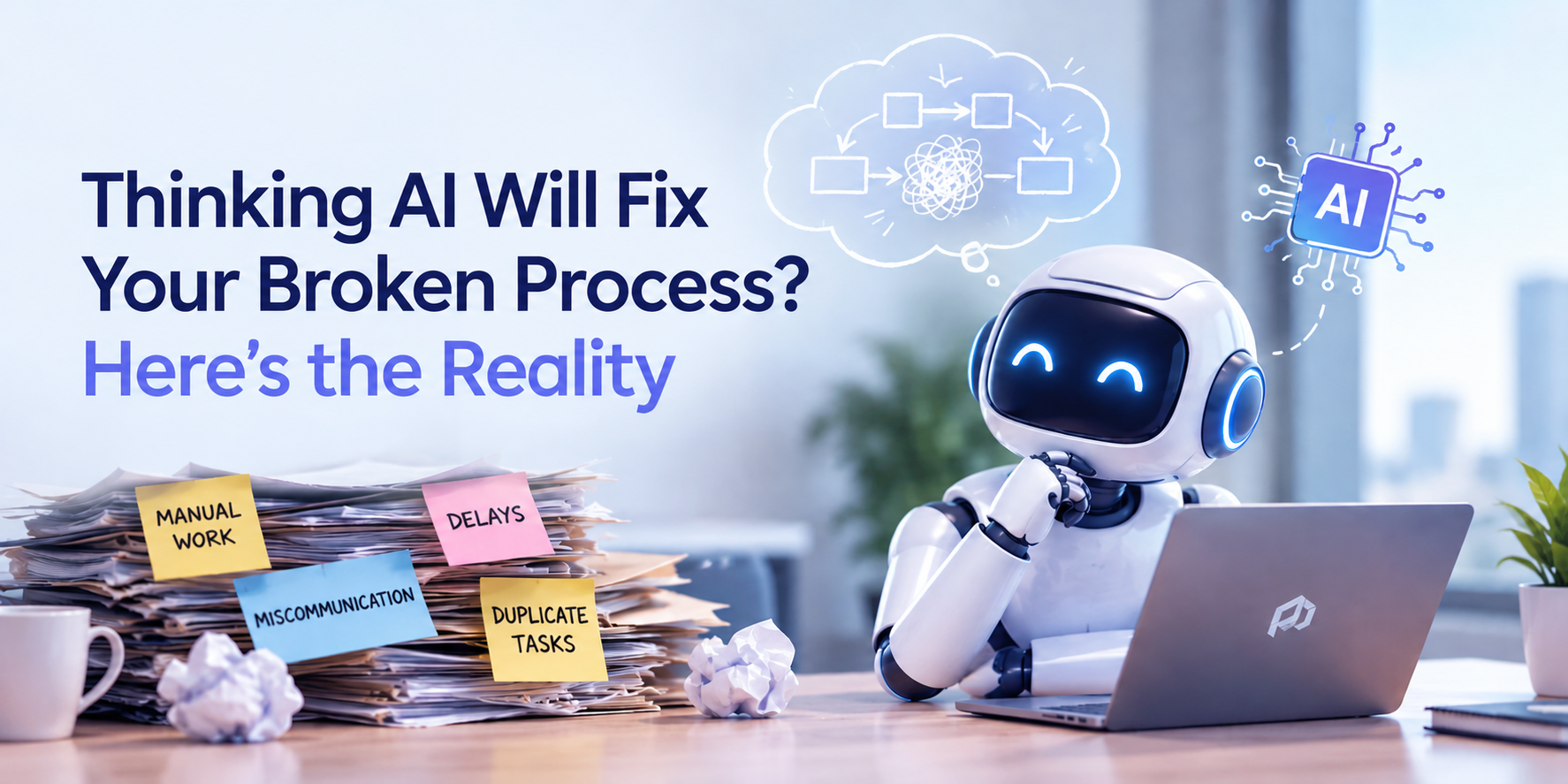
I get this question almost every week. A founder or operations lead comes to me convinced that once they “add AI” to their business, the chaos will sort itself out. The reporting will get cleaner. The bottlenecks will disappear. The team will finally be on the same page.
I wish it worked that way. It doesn’t, and it’s actually what pushed me to write AI Won’t Fix a Broken Process and Why Automation Needs Structure First for Brainz Magazine, where I go deeper into why this keeps happening.
Companies that struggle before AI tend to struggle after AI too, just faster and with more confusion. The tool changes. The underlying mess doesn’t.
AI Reflects Your Business, It Doesn’t Repair It
Whatever you put into AI, good or bad, is what you get back out. And by “input,” I don’t mean the prompt someone types into a chatbot. I mean your actual business. Your data. Your workflows. Whether your team understands the process they’re following, or if they’re just doing what the person before them did.
If that foundation is shaky, AI won’t smooth it over. It will amplify it. Before you invest in AI transformation, you need organizational clarity first.
A Tool, Not a Team Member
AI communicates naturally enough that it can feel like a colleague rather than a tool. But it works best with one clear job and the right information to do it, nothing more. I’ve seen companies feed an AI system everything they have, financial records, client data, internal documents, without thinking through access or sensitivity. That’s a governance problem waiting to surface, not smart automation.
Are You Using AI, or Is AI Using You?
Underusing AI holds a business back. Overusing it creates a quieter risk. I know professionals who’d genuinely struggle to get through a workday if their AI tool went offline.
A simple test I recommend: write your own first draft before you ask AI to respond to something important. Form your own opinion. Then bring AI in to sharpen it. If AI is reading the situation, deciding the response, and writing it for you start to finish, ask what you’re still bringing to the table.
Train People Before You Hand Them AI
We don’t let people drive without training first. I think about workplace AI the same way. Before I roll out AI tools with a client’s team, I make sure people understand what the tool actually does, what it can’t do, and how to question its output instead of accepting it blindly. Skipping this step is one of the most common reasons AI rollouts underdeliver.
Why Human Oversight Still Matters
AI gets things wrong sometimes. So do people. I build oversight into every AI system in layers. The AI handles the task first. A validation layer checks the output against the company’s own rules and standards. Then a human with enough context reviews it. The level of oversight should always match the level of risk.
The Real Question to Ask Before You Automate
AI can make a strong business faster and a capable team more effective. But it can’t hand your company a level of maturity it hasn’t earned yet. If your processes are broken, that needs fixing first. Then AI has an actual environment to succeed in.
If you want the fuller breakdown on governance, oversight, and how to roll AI out without breaking things further, my Brainz Magazine piece linked above covers it in more depth.
And if you’re weighing whether to bring AI transformation in-house or lean on outside support, I’ve also broken that down in our guide to choosing the right startup agency for your business.
So before you ask which AI tool your company needs next, ask the harder question first: is your business actually ready for it? Reach out to our team and we can walk through it together, or head over to pixelwave to see how we approach this with clients.