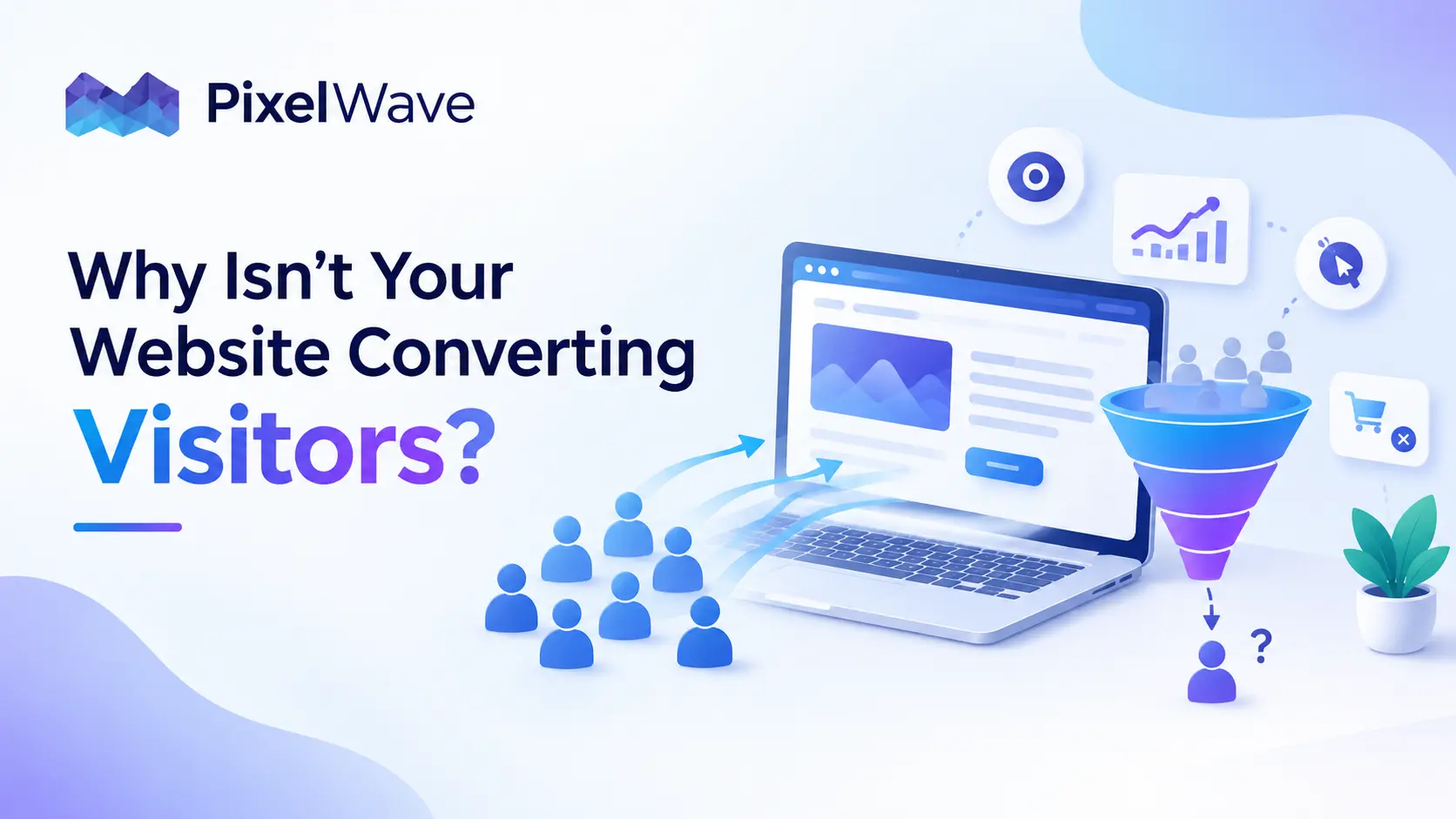
Why Do Most Business Websites Fail to Turn Visitors Into Customers?
Most business websites fail to convert visitors because they focus on looking polished instead of guiding people toward a decision. A site can bring in steady traffic and still lose almost all of it if the page loads slowly, the next step isn’t obvious, or nothing on the page gives a stranger a reason to trust the business enough to call, message, or buy. Traffic is rarely the real problem. Conversion is. If people are visiting your site but not reaching out, the cause usually comes down to a handful of fixable issues, not bad luck or the wrong audience.
More Traffic Won’t Fix a Conversion Problem
It’s tempting to assume the answer is simply more visitors. Run more ads, post more often, chase more clicks. But sending more people to a website that already struggles to convert just means losing more people, faster. At Pixel Wave, we see this pattern constantly with new clients: their digital marketing efforts are working exactly as intended, driving genuine, relevant traffic, but the website itself is the leak in the funnel. Before spending another dirham on ads or content promotion, it’s worth asking whether the website can actually convert the traffic it already has.
1. The Website Loads Too Slowly for Anyone to Wait
Visitors decide whether to stay or leave within the first few seconds. A page that takes too long to load, especially on mobile, loses people before they’ve even seen the offer. This is one of the most common and most overlooked reasons a business sees healthy traffic numbers next to disappointing enquiry numbers. Heavy, uncompressed images, bloated code, and cheap hosting are usually the real culprits, not the design itself. Fixing speed is often a technical job, but the payoff shows up directly in how many visitors stick around long enough to read an offer, let alone act on one.
2. The Call to Action Isn’t Clear Enough to Follow
A visitor who is interested but unsure what to do next will usually do nothing at all. Vague buttons like “Learn More” or “Submit” give no reason to click, and a page with five competing actions confuses people into picking none of them. Strong conversion pages ask for one clear action per page, written in language that matches what the visitor actually wants at that moment: a quote, a call, a free consultation. The words around that button matter just as much as the button itself, which is exactly why messaging and content creation deserve as much attention as the visual layout when a site is being built or fixed.
3. There’s Nothing on the Page That Builds Trust
People don’t buy from businesses they don’t trust, and a website is often the only chance to earn that trust before a first conversation happens. Real client work, genuine testimonials, clear credentials, and a consistent visual identity all signal that a business is established and reliable. A site that looks inconsistent, uses stock photography with no real substance behind it, or has no evidence of past work leaves visitors with nothing to hold onto. This is where branding does more than make a business look good. A consistent, well-defined identity across the site reduces hesitation and makes the decision to reach out feel safer.
4. The Mobile Experience Doesn’t Match the Desktop One
Most website traffic today comes from phones, yet many businesses still design for desktop first and treat mobile as an afterthought. Buttons that are too small to tap accurately, text that requires zooming, and forms that are awkward to fill out on a small screen all push mobile visitors away, even when the desktop version looks great. Since mobile visitors are often the closest to acting, whether they’re searching while comparing options or already looking for a phone number, a broken mobile experience can quietly cost a business its highest-intent traffic.
5. Visitors Don’t Know What to Do Next
Confusing navigation, unclear service pages, and a lack of obvious next steps leave visitors to figure things out on their own, and most won’t bother. A homepage that doesn’t answer “what does this business actually do, and is it for me” within a few seconds will lose people regardless of how much traffic reaches it. This is why the strongest-performing sites aren’t built around guesswork. They’re built around what real customers are actually searching for and asking, which is exactly the thinking behind designing pages around genuine market research instead of assumptions about what visitors want to see.
What Fixing a Conversion Problem Actually Looks Like
None of these five issues exist in isolation, and that’s usually the real reason a quick fix doesn’t move the numbers much. A faster site with no trust signals still won’t convert. A trustworthy site with a confusing mobile experience still loses people. Conversion improves when speed, messaging, trust, mobile experience, and navigation are treated as one connected system rather than five separate to-do items, which is the exact gap a full-service marketing agency is built to close, since design, content, branding, and marketing all end up pulling in the same direction instead of working against each other.
Frequently Asked Questions
How do I know if my website actually has a conversion problem?Check your analytics for the gap between traffic and actual enquiries or sales. If your visitor numbers are healthy but calls, form submissions, or purchases stay flat, the issue is almost always on the website itself, not the traffic driving people there.
Does website speed really make that much difference to conversions?Yes. Even a delay of a couple of seconds noticeably increases the number of visitors who leave before the page finishes loading, and that’s before they’ve even had the chance to see an offer or a call to action.
Should I redesign the whole website or just fix specific pages?Not always the whole site. Often the highest-impact fix is on the specific pages that matter most, like the homepage, service pages, or contact page, rather than a full rebuild. A quick audit usually reveals which pages are actually losing visitors.
The Bottom Line
A website that gets traffic but no enquiries isn’t failing because of bad luck or the wrong audience. It’s usually failing at one or more specific, identifiable points, and every one of them is fixable. Our team at Pixel Wave works through exactly this kind of diagnosis with clients regularly, looking at speed, messaging, trust, mobile experience, and navigation together rather than in isolation, because that’s how conversion problems actually get solved. If your site is bringing in visitors who never take the next step, it’s worth finding out exactly where they’re dropping off before spending more on driving traffic to a page that isn’t ready to convert it.